← home
session three

praise & knowing

to know, and to be known
song of songs 3:6 to 5:1
start the sessionread at your own pace
nick t ogle, phd
begin ↓
watch the teaching, then read at your own pace
praise & knowing
session three · teaching video
how to use this workbook

read this once

How to use this workbook. Some of this we walk through together, out loud, in the room. You do not have to write a word to follow along. Watch the screen. Listen. Be present. There is room on these pages to take notes as we go, and there are longer sections, marked GO DEEPER and THINK DEEPER, that we will not have time to fully cover together. Those are yours, for later. You will also find naked truth boxes throughout. Nuda veritas. These are for you alone. There are no wrong answers, and no one will read your responses unless you choose to share them.

A word before this one. This session, more than any other, talks about the body plainly, with its real names, and it talks frankly about what two lovers actually do. If that is new for you, breathe. This is not crude. It is reverent. We are going to do exactly what the Song itself does. Look closely at how a body is made, and at how two people come to know each other, and call all of it good. If you need to skip a section, skip it. Nothing here is meant to shame you. All of it is meant to free you.

prefer paper?
order the printed workbook

A beautiful keepsake edition, printed and mailed to your door, so you can write by hand, mark it up, and keep it on the shelf. An upgrade to your study.

add the mailed workbook
back
where we have been

WHERE WE HAVE BEEN

Two sessions in, look at the ground. We built the whole foundation. How shame got installed, what the science actually says, how to read in the light. We followed the lovers out into the springtime, the pursuit, the apps, the little foxes, the search in the dark streets, and learned that healthy love is two people running toward each other, present and chosen.

Now the poem arrives at its center. This session runs from a wedding procession blazing up out of the wilderness, through the most unashamed praise of a human body anywhere in Scripture, into the garden, and it lands, at last, on the consummation itself, with a voice from outside the lovers blessing the whole thing.

So this session is about two things that turn out to be one thing: praise, and knowing. Learning to speak the body without shame, and learning to know another person all the way down. Because you cannot truly praise or know a body you are ashamed of, we are going to do the thing the church almost never does. We are going to look, honestly and reverently and in correct terms, at how these bodies of ours actually work. Not to reduce the mystery. To deepen the awe. Then we are going to get very practical about how two people actually love each other well, because a study that stays in the poetry and never reaches the bedroom has failed you. The Hebrew holds two words we will carry the whole session: yada, "to know," which is also its word for sex, and dod, "the beloved," a word with an old, warm association of heat and boiling that I will be honest about when we get there. By the end you will see how they fit, and why the poem cannot stop using both.

notes · jot anything that stirs you as we go. saved on this device only.
now, read it aloud

hear the whole movement

Before we walk through it line by line, let the whole thing wash over you once. Read it slowly, out loud if you can. A procession, a praise, a locked garden, and a blessing over the bed.

hear
let us read it together

LET US READ IT TOGETHER

Read this aloud, slowly. Listen for the crowd craning to see the procession, the man praising every part of her, the woman opening her own garden, and then a voice from outside blessing the lovers. Friends announce it. He praises. She opens. He answers.

Friends Who is this coming up from the wilderness like a column of smoke, perfumed with myrrh and incense? Look! It is Solomon's carriage, escorted by sixty warriors. (3:6 to 7)

He How beautiful you are, my darling! Oh, how beautiful! Your eyes behind your veil are doves. You are altogether beautiful, my darling; there is no flaw in you. You have stolen my heart, my sister, my bride. A garden locked is my sister, my bride, a spring enclosed, a sealed fountain. (4:1 to 12, selected)

She Awake, north wind, and come, south wind! Blow on my garden, that its fragrance may spread everywhere. Let my beloved come into his garden and taste its choice fruits. (4:16)

He I have come into my garden, my sister, my bride; I have gathered my myrrh, I have eaten my honeycomb, I have drunk my wine and my milk. The blessing: Eat, friends, and drink; drink your fill, O lovers. (5:1)

Now let us walk back through it, slowly.

where you are, in this session
The assessment names the season you are in right now. Choose yours to see how this session speaks to you.
take the assessment to find your season →
come
part one · song 3:6 to 11

WHO IS THIS COMING UP FROM THE WILDERNESS

a couple dancing under a moon in watercolor
"Who is this coming up from the wilderness like a column of smoke, perfumed with myrrh and incense? ... It is Solomon's carriage... King Solomon made for himself the carriage; he made it of wood from Lebanon."3:6 to 9

The mood breaks open. From a woman alone in the dark, we go to a wedding procession blazing with light and smoke and spice. Someone is coming up out of the wilderness in a cloud of incense, and the crowd cranes to see. Who is this? A royal carriage, a wedding litter, carried by sixty armed men, built of the finest cedar, posts of silver, base of gold, seat of purple, lovingly made.

Whatever else is happening (scholars read the staging in different ways), the point at ground level is unmistakable. This is a celebration. Private desire has become a public feast. The love that ached alone in a dark bedroom is now paraded through the streets in daylight, crowned and cheered. The last line names it plainly: go out and look at the king "on the day of his wedding, the day his heart rejoiced" (3:11).

Let me be honest about something, though, because it actually strengthens what this study has argued all along. The Song is famously slippery about when, exactly, these two are married. There is wedding language here, but elsewhere the lovers meet in fields and vineyards and at night, the brothers fret over the woman's honor, and some scholars (Exum among them) argue the poem never clearly stages a wedding ceremony at all, that it is less the story of a wedding day than a sustained portrait of covenant love itself. I do not need to resolve that debate to make the point, and here is why it does not rattle me. The Song's ethic was never primarily about a ceremony. It was about covenant. Fidelity, exclusivity, self giving, belonging ("I am my beloved's and my beloved is mine"). Back in Session One I argued that Scripture's sexual ethic is built on covenant and faithfulness, not on a single legal moment. The Song's own beautiful vagueness about the wedding is quiet evidence for exactly that. The poem is soaked in the language of belonging and permanence from beginning to end, whether or not it ever pauses to show us the paperwork.

The day his heart rejoiced. Sit with that. This is what the church at its best has always understood, and what purity culture at its worst forgot. A wedding is not the end of desire, or the taming of it. It is desire crowned. It is the community gathering to say, out loud and in public, that this longing between two people is good, worth celebrating, and safe now to be seen. Many of us grew up in rooms where sex was the thing you whispered about, the thing that happened behind a locked door and was never spoken of again. The Song will not have it. It takes the most private longing a person can feel, and it throws a parade.

Private desire has become a public feast.

notes
now he looks, and he praises

the wasf

What comes next is one of the most remarkable passages in all of Scripture. A man looks at the woman he loves, and he praises her body, slowly, out loud, piece by piece. Slow all the way down.

praise
part two · song 4:1

HE LOOKS, AND HE PRAISES

a woman's silhouette before a rose colored moon, watercolor and splatter
"How beautiful you are, my darling! Oh, how beautiful! Your eyes behind your veil are doves."4:1

The man begins to speak, and he does something the church has almost never had the courage to do. He looks at the woman's body, and he praises it. Not in a rushed, embarrassed, keep it clean way, but slowly, lovingly, piece by piece, from her eyes down her body, naming each part and calling it beautiful. This kind of poem has a name. Scholars borrowed it from Arabic love poetry and call it a wasf, literally "a description," a head to toe praise song of the beloved's body. The Song contains several. This is the first and most famous. And it is not a Hebrew oddity. The wasf is a documented Ancient Near Eastern and Semitic form, and Michael Fox showed the close kinship with the Egyptian love songs, where lovers also praised each other's bodies part by part. The Song is a master of an ancient, honored genre. Praising your lover's actual body, out loud, in detail, is one of the oldest holy things human beings have done.

Stop and feel how countercultural this is, in his world and ours. In his world, one that often treated a woman's body as property or as a source of shame, here is a man gazing at his beloved and turning her body into poetry. And in our world, one that treats a woman's body as a product to be graded, airbrushed, and sold, here is a man who looks at one real woman and says: there is no one like you, and he means all of her. The wasf is desire given a liturgy. It is attention turned into worship. It is the opposite of a leer, and it is the opposite of shame.

notes
read
part three · song 4:1 to 5

READING HER BODY, LINE BY LINE

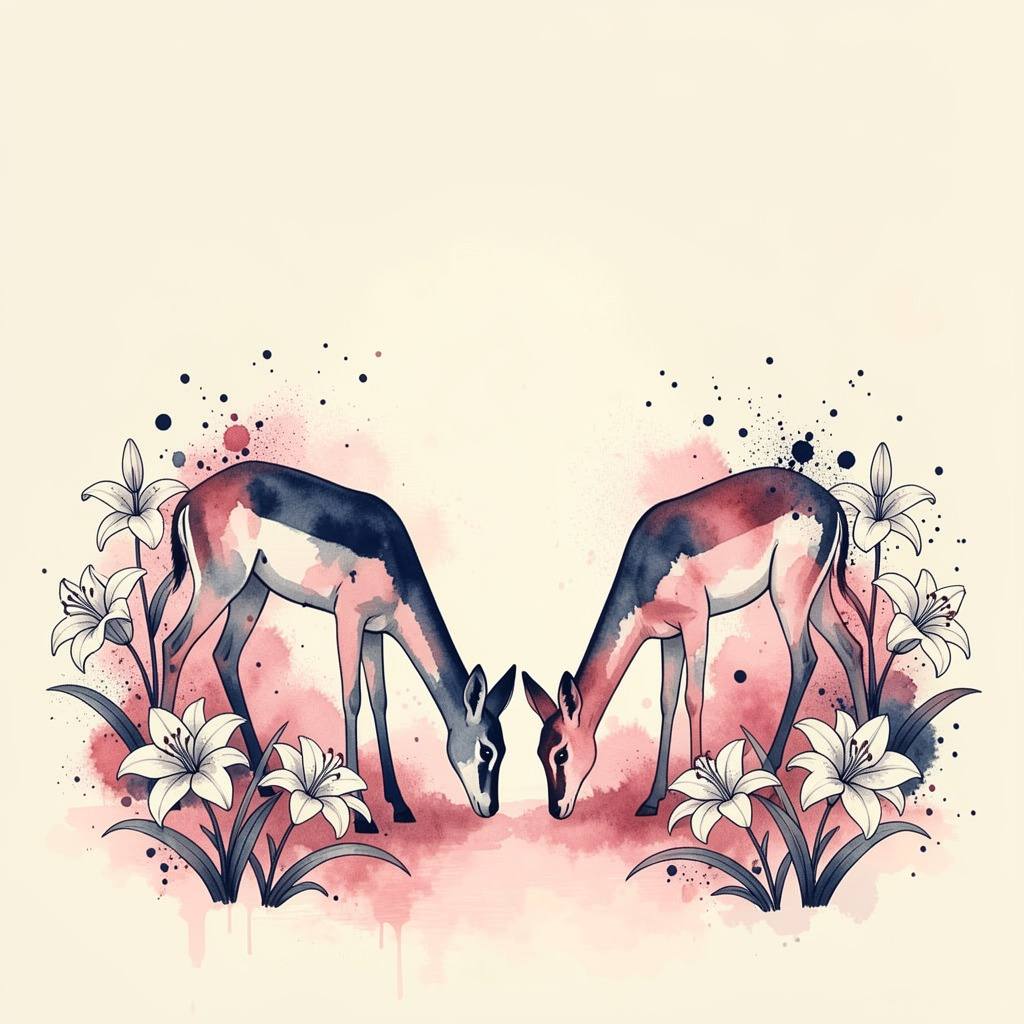
"Your hair is like a flock of goats descending from the hills of Gilead... Your two breasts are like two fawns, twins of a gazelle that browse among the lilies."4:1 to 5
a young fawn among lilies, the poem's own image for her body

Some of these comparisons sound strange to a modern ear. Your hair is like a flock of goats? Your teeth are like sheep? If a man said that today he might get slapped. So we have to understand what the images are actually doing, because once you see it the whole poem opens up.

Here is the key, and scholars like Fox have made it clear. These are almost never about literal visual likeness. They are about movement, and dignity, and abundance, and life. Picture the hair, not the smell of goats, but a whole flock of dark goats streaming down a green hillside at dusk, that rippling, flowing motion of a hundred dark bodies in the light. That is her dark hair in motion, falling as she turns her head. The teeth, a flock just shorn and washed, each with its twin, none missing, means her teeth are white, matched, a full and perfect set, which in a world with no dentistry was a real and rare beauty. The lips, a scarlet ribbon, bright, vivid, delicate. The neck like the tower of David hung with shields is not about thickness. It is about bearing. She carries herself with strength and dignity, holds her head like a queen. And the two breasts like two fawns browsing among the lilies is frankly sensual and does not apologize, soft, gentle, a matched and tender pair, praised openly, and Scripture lets him.

Do you see the thread? He is not grading her against a standard. He is delighting in her, reaching for the most beautiful living things he can think of (hills, flocks, towers, young animals at play) to say what she stirs in him. Praise, real praise, does not measure. It marvels. This is how love actually talks, not in generic compliments ("you look nice") but in specific, unhurried, particular delight. He looked long enough to find words. Most relationships starve for exactly this.

notes
flaw
part four · song 4:7

THERE IS NO FLAW IN YOU

"You are altogether beautiful, my darling; there is no flaw in you."4:7

After the long, loving gaze, he lands on a single sentence, and it may be one of the most healing in the whole Bible. "You are altogether beautiful, my darling. There is no flaw in you."

Look closely at the word "flaw." In Hebrew it is mum, and it is a striking word to use here, because in the rest of the Old Testament it is almost a technical term. It is the word for a blemish, and it is used above all of the animals brought for sacrifice. An animal offered to God had to be without mum, unblemished, unspotted, whole. It was the word for something perfect enough to be holy. And that is the word he uses for her. You are without blemish. There is nothing about you that has to be hidden or fixed before you can be adored, and what I see when I look at you is not just beautiful, it is holy, fit for the altar.

Now hold that against what most of us actually carry. Almost every person in this room has a running list of the parts of themselves they believe are flaws. The stomach, the scars, the stretch marks, the thing a parent said, the thing a partner said, the body that does not look like the screen. We carry that list into the bedroom, into the mirror, into every moment of intimacy, and it robs us. And here is Scripture, in the mouth of a lover, saying the exact opposite: there is no flaw in you.

Shame hunts for the blemish. Love cannot find one.

This is not him lying, or flattering, or failing to notice she is an ordinary mortal. It is love seeing truly. Love does not pretend the beloved is a magazine cover. It looks at a real body, an actual person, and finds them, genuinely, without flaw, because love is not grading. That is the difference between being looked at by desire and being looked at by shame.

And I need to widen "there is no flaw in you" to the bodies this study has so far quietly left out, because the whole anatomy we are about to walk through assumes a body that is able, pain free, and predictable, and a great many beloved, image bearing people do not live in one. Some of you have a disability, a chronic illness, chronic pain, a spinal cord injury, a body altered by surgery or age or disease, a body that does not do what the manuals assume. Hear this without a single asterisk. There is no flaw in you was not spoken over an idealized body. It was spoken over a real one, and it is spoken over yours. The theologian Nancy Eiesland, who lived with a disability, went so far as to write of The Disabled God, pointing out that the risen Christ kept his scars, that resurrection did not erase the wounded body but glorified it. Intimacy for a body that works differently is not a lesser, consolation version of the real thing. It is simply intimacy, which was always about presence, attention, creativity, and the giving of a self far more than about performing a standard script. The couple navigating illness or disability often knows something the able bodied learn late or never, that pleasure is wider than one act, that tenderness improvises, that being fully known does not require a flawless body, only an honest one. The Song's ethic, learn this body, love this person, delight without grading, was built for every body in the room, not just the ones on the screen. Even the wider culture has occasionally told this truth beautifully. The 2012 film The Sessions (Helen Hunt earned an Oscar nomination for it) tells the true story of Mark O'Brien, a poet who lived in an iron lung after childhood polio, and his tender, awkward, deeply human journey toward sexual intimacy, a story that insists, without a shred of pity, that longing and dignity do not stop at the edge of a disabled body. If Hollywood can take that seriously enough to honor it, surely the church that reads "there is no flaw in you" can.

notes
🕯
nuda veritas
the naked truth

What is on your list, the parts of yourself you have decided are flaws?

What would it do to you to hear, and believe, "there is no flaw in you"?

✓ kept, on this device only
name
part five

WE HAVE TO SAY THE WORDS

The wasf praises the body without shame. Most of us were never taught to do that, or even to name the body plainly. So before we go further, we have to do the honest thing the Song does.

Most people never learned to call their own body parts by their true names. We were handed nicknames, "down there," "the private parts," as if the real words were dirty. So grown adults, even married ones, cannot say vagina or penis or clitoris to the person they sleep beside, and then we wonder why intimacy struggles. If you cannot name it, you cannot ask for it, protect it, or celebrate it. Naming is the beginning of honor. So we will use the real words. They are not shameful. They are the words for a wonder.

And here is the theology underneath the anatomy we are about to walk through, the one we keep returning to: "I praise you because I am fearfully and wonderfully made; your works are wonderful, I know that full well" (Psalm 139:14). When you actually understand how the body is made, down to the smallest design, you do not find something to be ashamed of. You find a wonder. And behind the wonder, a Maker. I have taught this for twenty years, and I will tell you plainly: the more precisely you understand the human body, the harder it becomes to believe it was an accident. The design is too good.

her
part six

THE BODY, HONESTLY: HER

a woman's silhouette before a glowing moon, watercolor and splatter

Open any anatomy text and the female reproductive system takes more describing than the male. There is simply more going on, so much that it is usually split into two categories, external and internal. Let us walk it, reverently and in correct terms.

The vulva is the correct name for the external parts, together, not "the vagina," which is the internal canal (this mislabeling itself is a symptom of how little we were taught). And the first thing to say is: they all look different. Different shapes, sizes, colors, the way they change with arousal, all different, all normal. Pornography sells one supposedly ideal type, and then people spend their lives ashamed of a body that was never wrong. One of the fastest growing cosmetic surgeries in America is now labiaplasty, women having healthy tissue cut to look like a photograph. Hear this gently and firmly: comparison always breeds discontent. If you measure your body against a screen, you will always lose, because the screen is a lie.

notes
🕯
nuda veritas
the naked truth

What did you learn, or never learn, about your own body, and who taught you?

What is one part of yourself you would like to be able to call "a wonder" and mean it?

✓ kept, on this device only
him
part seven

THE BODY, HONESTLY: HIM

a man's silhouette before a moon, watercolor and splatter

The male body is more external, more straightforward, and it has spent history buried under absurd myths, that sperm came from the brain, that a woman jarred hard enough could sprout a penis, that "every time a man touches himself a kitten dies." We laugh, but shame always travels on bad information. Accurate knowledge is how you get free of it.

notes
respond
part eight

HOW THE BODY RESPONDS: THREE MAPS, AND THE CHEMICALS

If you are going to love a body well, it helps to know how it moves through arousal, and the researchers who mapped it left us several complementary maps worth knowing.

Masters and Johnson (1966), the four phase cycle. When William Masters and Virginia Johnson brought sex into the laboratory and measured it, they described a physical arc: excitement (arousal begins, blood flow, lubrication, erection), plateau (arousal intensifies and holds), orgasm (the release), and resolution (the body returns to rest). They also documented the difference most couples feel but never understood: a man's orgasm is typically shorter (5 to 7 seconds) and followed by a refractory period (recovery time before he can go again); a woman's can last longer (often 15 to 40 seconds) and, crucially, often has little or no refractory period, which is the physiological basis for multiple orgasms. Knowing this one fact reshapes a couple's whole rhythm.

Kaplan (1979), desire comes first. Helen Singer Kaplan looked at Masters and Johnson and said: you left out the beginning. Her triphasic model put desire first (the wanting, which lives in the mind and the emotions), then excitement, then orgasm, and by doing so she reoriented sex therapy around the mind and the relationship, not just the plumbing. This is why "low desire" is so rarely a mechanical problem and so often a relational one (recall Session Two's brake and accelerator).

Reed, the Erotic Stimulus Pathway. David Reed gave the most human map of all, in four movements: Seduction (the courtship, the flirtation, the anticipation, which is why dating never stops in a good marriage), Sensations (the building physical pleasure), Surrender (the letting go of orgasm, and note the word: you cannot force it, you can only surrender to it, which is why anxiety and performance pressure are its enemies), and Reflection (the afterward, how you feel about what just happened shapes whether you will want it again). That last stage is one most couples ignore and should not: the tenderness after is part of the sex, not an epilogue.

Basson (2000), the map that saves marriages. There is a fourth map, the most important one for long married couples, and almost no one in church has ever heard it. The sex researcher Rosemary Basson noticed that the older models all assume desire comes first, you feel spontaneously turned on, and then you act. That is often true in early love and often true for higher desire partners (frequently, not always, men). But for a great many people, especially women, and especially in long relationships, desire works in a circle, and it comes second. You start from a neutral place, not particularly "in the mood." You choose, out of love and openness, to be close, to let yourself be touched, to receive affection. The arousal builds. And then the desire shows up, kindled by the closeness rather than preceding it. This is Session One's responsive desire given its clinical name, and understanding it undoes an enormous amount of shame and blame: the lower desire partner is not "broken" or "not attracted" because they do not walk around spontaneously craving sex. Their desire simply ignites in the doing rather than before it. The practical gold in Basson's circle is this: if you wait to "feel like it" before you ever begin, you may wait forever, but if you willingly step toward closeness, the wanting very often follows. For countless couples that single insight is the difference between a dead bedroom and a living one.

And the one clinical fact that heals the most shame: arousal nonconcordance. Hear this carefully, because it rescues people who have carried a secret for decades. Your body's response and your mind's wanting are two different systems, and they are only loosely wired together. Researchers put the overlap around 10 percent in women and roughly 50 percent in men (Chivers, Nagoski). In plain terms: your genitals responding does not always mean you want it, and your genitals not responding does not mean you do not. A woman can lubricate without desire; a man can want his wife deeply and still lose an erection to stress or exhaustion. Two things follow, and both are liberating. First, the everyday version: "my body did not respond, so something is wrong with me," or "he went soft, so he must not find me attractive," both are usually just nonconcordance, not a verdict on the marriage. Second, and far more important, the version that sets prisoners free. Many survivors of sexual abuse experienced physical arousal, or even orgasm, during the abuse, and spent years believing that meant they "wanted it" or were complicit. They did not. The body's response was a reflex, wired into the tissue, utterly disconnected from consent or desire. If that is you, hear it as clearly as I can say it: your body's reaction was not your consent, and it was not your fault. The plumbing firing is not the soul agreeing. This one piece of science has lifted more shame, in my experience, than almost anything else in this study.

And the chemicals. During arousal and especially at orgasm, the body floods with the same cast we met in Session One: dopamine (reward and drive), oxytocin (the bonding hormone, released in a rush at orgasm, and this is a large part of why sex bonds people, "one flesh" at the level of the bloodstream), and, afterward, a wave of calming prolactin and serotonin (which is why people often feel sleepy and peaceful after, men especially). Understanding the chemistry takes the mystery out of some very common experiences: why sex bonds you to whomever you have it with, why the afterglow feels the way it does, and why the body was so clearly built to attach.

notes
made
part nine

WHY THE BODY IS BUILT THIS WAY

Step back and look at everything we just walked through, and a single thread runs through all of it. The bone left out of the penis. The pleasure that shifts over the years. The clitoris whose only job is joy. The parts that have to be learned. The arousal that takes time and trust, and the orgasm you can only surrender to. Every one of these design choices points the same direction.

Most animals are built to reproduce and move on, fast and automatic. A honeybee, a rabbit, most of the animal kingdom: sex is over in seconds, because the vulnerable moment must be short. Humans were built to linger. If God had only wanted us to make babies, he would have made us like the animals, quick, driven, done. Instead he made a body that has to be learned, that rewards attention, that deepens with time and knowledge, that keeps changing so a couple can never coast, never stop paying attention, never be finished discovering each other.

Now let me be honest about what kind of claim I am making, because it matters. This is not something the Song of Songs sets out to prove, and it is not a knock down scientific argument. It is my devotional reading of the evidence, and you are free to disagree. But when I look at all of it together, the body built for slowness and attention rather than speed, it reads to me like a theology written in nerve endings: a Maker who designed the body so that love would have to be unhurried, attentive, and lifelong. The wonder of the body is not just that it works. It is that it seems built, from the ground up, to make two people take their time knowing each other. And knowing, it turns out, is exactly where the whole poem is heading.

notes
talk
part ten

HOW LOVERS ACTUALLY TALK: EROTIC COMMUNICATION

Here is the single most important practical skill in a lifelong sexual relationship, and almost no one is ever taught it: how to actually talk about sex. The whole wasf is a man saying out loud what he sees and loves, specific, unhurried, particular. And that is the rarest thing in most relationships. Two people stop speaking desire to each other, sometimes for decades, and then wonder why the fire went out. So let us learn it, from the Song and from the therapy room.

Metacommunication, talking about how you talk. Here is counseling language that changes marriages. Metacommunication means communicating about your communicating. Most couples, when sex is hard, either avoid the subject entirely or fight about the content (who did what, who wants what, who is falling short). The couples who break through learn to step back and talk about how they talk about it: Why is this so hard for us to discuss? What happens in your body when I bring it up? What would make this feel safe? That conversation, the one about the conversation, is where the healing starts.

Context versus content. In any exchange there is content (the details, the actual request or complaint) and context (the bigger picture, the who and the why, the whole emotional weather the words land in). And I have watched this over and over. Most sexual miscommunication is not a content problem. It is a context problem. She is not really upset about the specific act or the specific night; he is not really shut down over the specific request. The content is the surface. The context, feeling unseen, feeling pressured, feeling unsafe, carrying an old wound, is the real conversation. Learn to ask what is actually going on underneath, and half your fights about content dissolve.

The power of a name. Watch what the Song does with names, "my dove," "my sister, my bride." Naming is intimacy. To speak a tender, particular name over someone, and to name out loud what you want and what you love, is itself an act of closeness. Most of us can name what we are angry about far more easily than what we desire. Learn to say the specific, loving, wanting thing out loud. It is not awkward. It is the whole point.

From performance to presence. And here is the freed move all of this is building toward. So much of what wounds our sexuality is that we turn it into a performance, a test to pass, a scorecard: Am I good enough, big enough, desirable enough, doing it right? The Song offers something else: sex as knowing. Not performing for someone, but being present to them, and letting them be present to you. Presence, not performance. That single shift, from am I doing this right to are we here with each other, undoes more sexual shame than any technique ever could. Masters and Johnson gave the problem a precise name: spectatoring, mentally stepping outside your own body during sex to watch and grade the performance ("do I look okay, am I taking too long, is this working"). It is the exact same self surveillance we named as self objectification back in Session Two, now smuggled into the bedroom, and it is a reliable killer of both arousal and orgasm, because you cannot be lost in a pleasure you are standing outside of, scoring. The cure is not trying harder. It is coming back, back into the sensations, back into your own skin, back to the person in front of you. Presence is the antidote to spectatoring, and presence is the whole game.

There is real clinical science here, not just a nice idea. When Masters and Johnson moved from studying sex to treating it, the core technique they built was called sensate focus, and it is, essentially, presence over performance made into a practice. A couple struggling with anxiety, pain, or "dysfunction" is told to take intercourse and orgasm off the table entirely for a while, and simply take turns touching each other, not to arouse, not to achieve anything, just to notice, to pay attention to warmth, texture, sensation, with no goal and no test to pass. Removing the goal removes the brake (remember the accelerator and brakes from Session Two): when there is nothing to fail at, the anxiety that was blocking arousal drains away, and desire returns on its own. It works because it is the exact opposite of performance. And the modern evolution of this is mindfulness based sex therapy. The psychologist Lori Brotto (Better Sex Through Mindfulness, 2018) has shown, in rigorous studies, that teaching people to bring nonjudgmental, present moment attention to their own bodily sensations measurably restores desire and arousal, especially in women, because so much of what kills desire is being in your head (grading, worrying, self objectifying) instead of in your body. This is yada, presence, knowing, translated into an evidence based clinical tool. The Song had it three thousand years early.

notes
🕯
nuda veritas
the naked truth

When did you last say out loud, specifically, what you wanted, not "that was nice," but the real, particular thing?

What makes naming desire so much harder than feeling it?

✓ kept, on this device only
garden
part eleven

THE PRACTICE: loving each other well

A study that names the body and never speaks about the practice has left you at the door of the garden and refused to let you in. So let me be a professor and a pastor about how two committed people actually love each other well, frankly, without shame, and with the same ethical spine we use for everything: is it permissible? is it beneficial? is it consuming? is it mutual and consented, on both sides? Within that frame, and between two people who belong to each other, the Song's own answer to "what is allowed?" is startlingly generous, "eat, friends, drink; drink your fill" (5:1). The garden is meant to be enjoyed.

Give people direction, not a wall of text. So here, plainly, is where to actually put your attention. Try one this week.

try it · i
browse among the lilies

Foreplay is not the warm up. It is part of the meal. Slow all the way down. Unhurried touch, kissing, the whole body attended to. This is the sex, not the preamble.

try it · ii
learn this body, now

Where and how your partner likes to be touched differs, and it changes over time. Ask. "Show me. Tell me. Is this good?" are the most romantic questions there are.

try it · iii
praise it out loud

Do the wasf. Name one specific, true thing you see and love about your partner's actual body. Not "you look nice." Real, particular, unhurried delight.

try it · iv
name what you want

Say the specific, loving, wanting thing out loud, the real request, not the vague hint. Naming desire is the whole point, and it is learned, not magic.

try it · v
play, your whole life

You are allowed to have fun. Adventurous, silly, spontaneous, bold. Build a shared, private list together and work down it, laughing, over the years.

try it · vi
presence, not performance

Come back into your own skin. Stop grading. The shift from "am I doing this right" to "are we here with each other" heals more than any technique.

notes · which one will you try?
taste
part eleven, continued

THE GARDEN, HONESTLY

Foreplay is not the warm up; it is part of the meal. Recall "he browses among the lilies" (2:16), the unhurried, exploratory grazing. The single most common complaint I hear from women in decades of counseling is that sex became efficient, that the lingering disappeared. The research is blunt: in long marriages, foreplay often shrinks to a handful of minutes. Slow down. The seduction and sensations stages (Reed) are where most women's arousal actually lives. Unhurried touch, kissing, the whole body attended to, this is the sex, not the preamble to it.

Touch, breasts, and knowing what turns each of you on. Learn where and how your partner actually likes to be touched, and understand that it differs between people and genuinely changes over a lifetime, with hormones, age, health, and experience. Breast and nipple stimulation is, for many women, a direct pathway to arousal and for some even to orgasm on its own. The nipples are richly nerved and, notably, stimulating them releases oxytocin, the same bonding hormone, which is part of why it deepens closeness and not just excitement. None of this is guesswork you are supposed to magically know. It is learned, by paying attention, and by asking. "Show me. Tell me. Is this good?" are not unromantic questions. They are the most romantic questions there are.

Oral sex, and a direct word to those taught it was dirty. I have to speak plainly here, because a specific strand of American Christianity, much of the Baptist and fundamentalist teaching many of you grew up under, taught that oral sex, even between a married husband and wife, was shameful, "unnatural," or sinful. I want to say, as clearly as I can: that teaching is not in the text, and the Song actually pushes against it. Look at the poem's own imagery: "his fruit is sweet to my taste" (2:3); "let my beloved come into his garden and taste its choice fruits" (4:16); "I have eaten my honeycomb, I have drunk my wine and my milk" (5:1). The Song reaches, again and again, for the language of tasting the beloved, mouth to body, and calls it good, and God blesses it. Between a married couple, mutually desired, oral intimacy is a normal, honored part of the garden. The shame attached to it was cultural, not biblical, and it has needlessly wounded a great many marriages.

Anal sex, the honest facts, no hype and no panic. Couples ask, so I will answer plainly. It is more common than it used to be (partly, honestly, because pornography has normalized it as a supposed expectation, which is its own problem, when a couple imports a performance rather than discovering their own desire). The honest medical facts matter: the anal tissue is delicate and does not self lubricate, so it tears more easily and carries a higher risk of infection transmission, which means, if a couple chooses it, lubrication, patience, hygiene, and genuine mutual desire are non negotiable, and it is never something one partner should pressure the other into. As with everything in the garden: mutual, consented, unhurried, and free of coercion, or not at all. I neither forbid it nor prescribe it. I hand you the facts and the ethical frame and trust you as adults.

Toys, role play, kink, and fantasy. Within a committed, consenting relationship, the imaginative and playful dimensions of sex, toys, role play (remember, the Song's lovers invented the "royal game"), the shared use of fantasy, gentle exploration of what excites each of you, are not automatically sinful, and treating them as such has often driven couples' desire underground rather than removing it. The three questions govern here as everywhere: is it beneficial (does it draw you together or pull you apart)? is it consuming (has it become compulsive or a substitute for the person)? is it mutual (freely wanted by both)? Fantasy in particular is worth naming honestly: the imagination is part of our erotic life, and the question is always the same, is it a doorway you open to let your partner know you more fully, or a hiding place you escape into away from them? Used to reveal, it builds intimacy. Used to hide, it isolates.

Playfulness, adventure, and a permission slip. Here is something the Song models that the church almost never blesses: sex is meant to be playful. These lovers meet in vineyards and gardens and the open countryside, under "cedar beams" and "green" canopies (1:16 to 17), on the move, out of doors, inventing games. They are not solemn. They are delighted. So let me hand you, plainly, a permission slip most of you were never given: you are allowed to have fun. You are allowed to be adventurous, silly, spontaneous, and bold with the person you belong to. Many long married couples find it revives them to make a shared, private list together, the things they are curious about, the places they would love to make love, the fantasies they would like to try, and then to work down it, laughing, over the years. (Yes, some couples put "the mile high club" on the list. That century old wink about sex on an airplane exists precisely because humans keep sensing that desire is meant to be an adventure, not a chore.) The one rule is the rule of the whole garden: mutual, wanted, unhurried, and free. Build the list together; never pressure a partner onto it. But do not let a lifetime of shame convince you that holy sex must be dull sex. Playful sex, adventurous sex, laughing together sex, this is not a compromise of the sacred. It is the sacred, enjoying itself. And it does not stop at forty, or sixty. Keep playing your whole life long. The sex columnist Dan Savage gave the culture a useful little rule of thumb for lovers, be "GGG": good, giving, and game, that is, skilled, generous, and open minded toward your partner's desires within the bounds of what you are each glad to do. Strip the slang and it is very close to the Song's own ethic of glad, mutual, generous delight.

Lingerie, costumes, scenes, and games, the theater of desire. Notice how much of the Song is staged: the lovers dress the encounter in perfume and jewels and fine cloth, they play the "royal game" (she casts him as a king, he casts her as a bride), they set scenes in gardens and chambers and vineyards. Eroticism has always loved a little theater, and there is nothing shameful in it. Lingerie, a costume, a playful role, a game with rules the two of you invented, these are not the tools of the corrupt. They are the tools of couples who refuse to let desire go gray. Dressing up for your beloved, playing a part, building anticipation with a scene, this is courtship continued, the pursuit of Session Two carried into the bedroom for decades. Play.

A plain word about lubrication, and no shame in it. Because nobody says this from a pulpit and it needs saying: using lubricant is normal, common, and nothing to be embarrassed about. Bodies are not machines. Natural lubrication varies with the menstrual cycle, with stress, with medication, with age, with how much unhurried arousal there has been, and after menopause it changes for nearly everyone. Needing lube is not a sign that something is wrong with you, that you are "not attracted enough," or that your body is failing. It is a sign that you are a human being with a real body, and a small bottle from the drugstore removes a completely unnecessary source of pain and anxiety. Reducing friction reduces discomfort and increases pleasure, full stop. Any couple who has been together a long time should have it on the nightstand and think nothing of it. The shame around it is one more needless little tax that purity culture put on ordinary bodies. Stop paying it.

Watching and being watched: mirrors, filming, and "putting it out there," with one bright line. Some couples find that being seen by their own partner, a mirror in the room, filming themselves for their own eyes, one watching the other, heightens desire; others love the reverse, the delight of watching their beloved. There is a real thread of this in the Song itself, which is saturated with the joy of the gaze: "let me see your face" (2:14), the long adoring looking of the wasf, the lover who says "you have captured my heart with one glance of your eyes" (4:9). Being looked at with delight, and looking with delight, is woven right into the poem. Between two committed, consenting partners, that playful pleasure of watching and being watched is part of the garden. But here is the bright line, and it is not negotiable. There is a world of difference between consensual play between two people who both want it, and what the clinicians call voyeuristic or exhibitionistic disorder, spying on, or exposing yourself to, people who have not consented. The first can be a couple's joyful secret. The second violates someone, is a genuine harm, and is a crime. The whole ethic of this study lives in that distinction: consent and dignity. And a hard, practical caution on the "putting it out there" question. Couples who photograph or film their own intimacy must understand that anything captured to a device can be copied, hacked, leaked, or weaponized in a future breakup. Countless people have been wounded this way. If you make something, understand the risk, keep it truly private, and never, ever create or share it under pressure. Made freely, held wisely, for your eyes alone, the theater of being seen by the one who loves you is part of the play. Handed to a machine that never forgets, it can become a wound. Know the difference.

Aphrodisiacs and "sexual comfort zones." A quick honest word: most classic "aphrodisiac" foods (oysters, chocolate) have little proven physiological effect. The real aphrodisiac is context and anticipation (the mind, again). The Song's own aphrodisiac, the mandrake (which we will meet in Session Five, 7:13), worked mostly by belief and ritual, which is itself the point: desire is cultivated, set a scene, built by attention, not swallowed in a pill. And a gentle frame for exploring: every couple has a comfort zone, and growth happens at its edges, together, never by one person dragging or shaming the other across a line. Curiosity, yes. Coercion, never.

notes
🕯
nuda veritas
the naked truth

What is one thing about your own sexual life you were taught was shameful that you now suspect was cultural, not biblical?

What would it mean to bring it into the light and ask honestly whether it is actually harmful, or just something you were told to fear?

✓ kept, on this device only
self
part twelve

MASTURBATION AND SELF KNOWLEDGE

We cannot leave the body without the most private, most silenced, most sermon avoided subject in the whole conversation: self knowledge, and yes, that includes masturbation. I will handle it the way I handle everything: honestly, without a rule handed down from on high, and with enough information that you can make a whole and owned decision.

Let me ask what I ask every room: have you ever heard a sermon on masturbation? Almost no one has. And in that silence, shame grows like mold, in the dark, unspoken, unexamined. Let us turn the light on.

For most of Christian history, masturbation was taught flatly as sin, a sign of weak character, of a person who could not control himself. Much of evangelical culture still does, or splits the hair that the act is not sin but the thoughts required are (which ties them together and lands right back at sin). But notice the honest tension even inside evangelical writing now. Much of it says what the wider culture already believes, that self stimulation is part of the body's natural response to itself, a way to learn your own chemistry and your own body, and that it can be healthy, with boundaries. Biologically there is little debate: it releases the same dopamine and serotonin your doctor is chasing when she tells you to exercise, the chemicals that lower anxiety, lift mood, and settle the nervous system. Even secular educators land on a similar boundary: healthy, as long as it is not fused with pornography (they do not want the bonding hormone oxytocin wiring a person to a screen instead of a partner). Everybody, it turns out, ends up talking about the chemicals. (A little history: in 1994 the U.S. Surgeon General, Joycelyn Elders, suggested masturbation might be taught as part of sex education. She was forced to resign shortly after. A generation later, that content sits in most sex education curricula. The culture moved.)

The frame I actually teach, three questions. I will not hand you a rule, because a rule you did not choose will not hold when it is just you at midnight. Instead, the same three questions I use for any behavior. Is it permissible? (Scripture, honestly, says very little directly; you have to study and decide.) Is it beneficial? (Does it produce good fruit, or pull you toward compulsive lust, isolation, and a wave of shame every time?) Is it consuming? (Anything that consumes us, food, work, even religion, steals our life; the question is not only "did I," but "is this running me?")

And the deeper thing: self knowledge. Scripture calls sex an act of one flesh, union with another. But "one flesh" assumes you have a self to bring. Many people were so busy managing, hiding, and fearing their own bodies that they never came to know themselves at all, never learned what they like, what they feel, what their own yes and no even are. You cannot give a self you have never met. Some of the truest self knowledge is not sexual touch at all. It is prayer, the honest "who am I" work, finally being on speaking terms with your own body. But for some, learning their own body, without shame, without compulsion, within boundaries they chose, is part of coming home to themselves, so that one day they have a whole self to offer another person. Purity culture taught people to be strangers to their own bodies and then expected them to be intimate on cue. The Song assumes something better: a person who knows themselves, and is not at war with their own skin, is a person who can actually love.

This hunger to finally learn one's own body is driving something real and worth naming: a whole movement of women reclaiming their sexual selves. Some of it is superb. The research based platform OMGYes, built in partnership with researchers at Indiana University and the Kinsey Institute, produced the first large scale, peer reviewed studies of what actually brings women pleasure; the pioneering educator Betty Dodson spent decades running workshops whose whole purpose was to dissolve women's body shame and teach them their own anatomy. And beyond the education there is now an entire landscape of women traveling to weekend seminars, sensuality workshops, and retreats to reclaim a desire that shame or a long marriage had put to sleep. I want to bless the healthy heart of this. Women refusing to believe their pleasure is unknowable or unimportant is a good thing, and the church should have been leading it instead of forcing it out into the marketplace. But wisdom requires one honest caution: that marketplace is unregulated, "sacred" and "trauma informed" are sometimes just marketing, and a few of these groups have turned coercive or predatory. The "orgasmic meditation" company OneTaste, held up for years as empowerment, ended with its leaders convicted of forced labor in federal court in 2025. So: pursue the good hunger, and vet the teacher. The goal is your self knowledge and freedom, never handing your body or your bank account to someone who has learned to sell you back what was always already yours.

And give credit where the modern knowing began. Nearly everything we now say plainly about women's bodies, that the clitoris is central to most women's orgasm, that women are capable of multiple orgasms, that desire and response continue into old age, was established in a laboratory by William Masters and Virginia Johnson, whose Human Sexual Response (1966) was the first rigorous study of what the body actually does during sex. They quietly overturned a mountain of Freudian nonsense that had shamed women for decades (the myth that a "mature" woman should orgasm one particular way). Their work is the science under this whole session, and a reminder that honest, careful attention to the body has a way of replacing shame with wonder.

notes
heart
part thirteen · song 4:9 to 11

YOU HAVE STOLEN MY HEART, MY SISTER, MY BRIDE

a couple embracing in a cloud of pink and blue watercolor
"You have stolen my heart, my sister, my bride; you have stolen my heart with one glance of your eyes... Your lips drop sweetness as the honeycomb; milk and honey are under your tongue."4:9 to 11

After praising her body, he names what it does to him: "you have stolen my heart with one glance of your eyes." One look. And the Hebrew here is a small marvel worth catching. The phrase "you have stolen my heart" is one word, libbabtini, a verb built straight from lev, the word for "heart." Hebrew makes a verb out of "heart." You could render it, roughly, "you have hearted me," or "you have un hearted me." It cuts both ways at once, and that is the point: with one glance she has taken his heart away (he is lost it, undone, no longer in possession of himself) and she has given him heart (filled him, emboldened, made him more alive than he was). To be truly seen by someone you love does exactly that. It steals your heart and hands you a bigger one in the same instant. One language, one word, both truths. And then he calls her something we have to slow down for, because it trips up modern readers: "my sister, my bride."

Sister? Let me put your mind at ease immediately. This is not what it sounds like to us. In the ancient Near East, and especially in the Egyptian love poetry we have kept meeting, lovers routinely called each other "my brother" and "my sister" as terms of deepest endearment. It signaled closeness, equality, a bond as permanent and unbreakable as family, layered on top of the passion of a lover. He is not saying she is his sibling. He is saying she is both, the fire of a bride and the settled, forever belonging of family, in one person. He says it four times across these two chapters because he cannot get over it. She is his lover and his home. (Hold that fusion, the fire and the family in one breath, because in Session Six a single Hebrew word, dod, is going to hand it right back to us.)

And notice the register of the praise: "your lips drop sweetness as the honeycomb; milk and honey are under your tongue." That last phrase is worth a pause, because milk and honey is the very phrase the Bible uses for the Promised Land, the land flowing with milk and honey, the place of arrival, rest, and abundance after a long wilderness. He takes the language of the homeland every Israelite longed for and lays it on the mouth of his beloved. She is his Promised Land. She is where the wandering ends. That is not a throwaway compliment. That is a man saying: in you, I have arrived. In you, I am home.

notes
now the image that was misused for centuries

a garden locked

He calls her a garden locked, a spring enclosed, a sealed fountain. For a long time that line was preached in one narrow way. Read it more carefully, and it turns from a warning into a treasure.

sealed
part fourteen · song 4:12

A GARDEN LOCKED

two silhouetted lovers under a stone arch wreathed in flowers, watercolor
"A garden locked is my sister, my bride, a spring enclosed, a sealed fountain."4:12

Now comes an image that has been used, and badly misused, for centuries. He calls her "a garden locked, a spring enclosed, a sealed fountain." For a long time this line was preached in one narrow way, as a verse about virginity. She is locked, sealed, untouched, and the whole weight fell on a young woman's job to stay closed. That reading is not nothing (chastity is a real theme in the book), but if we stop there we miss something far richer and far more freeing, and we hand the verse over to exactly the shame this study exists to undo.

So read it more carefully. A locked garden is not first of all a warning. It is a treasure. In a dry and dangerous land, an enclosed garden with its own sealed spring was the most precious, protected, life giving place there was, a private paradise, lush and fragrant, that not everyone got to enter. To call her a locked garden is to say she is not common ground. She is a guarded treasure, a self of infinite worth, and that is a thing to honor, not merely to police.

And here is the part the old sermons almost always skipped, the part scholars like Phyllis Trible and Cheryl Exum have insisted we see: the garden is hers. It is her spring, her fountain, her enclosed and fragrant self. She is not a locked box that belongs to someone else and waits to be opened by a man with the key. She is a whole person, self possessed, who holds the gate. (There is real beauty in the older allegorical reading too, the soul enclosed for God alone, a sacred guarded space, and we hold it with respect. But even the allegory only works because the plain, human image is so strong: a whole person, sealed and full, who chooses whom to let in.) Which sets up what happens next, one of the most quietly radical moments in the whole book.

notes
open
part fifteen · song 4:16

LET MY BELOVED COME INTO HIS GARDEN

a man and a woman standing close, face to face, before a warm moon, watercolor
"Awake, north wind, and come, south wind! Blow on my garden, that its fragrance may spread everywhere. Let my beloved come into his garden and taste its choice fruits."4:16

And here she speaks, and it changes everything. Right after he calls her a locked garden, she opens her mouth and takes command of the wind itself: "Awake, north wind. Come, south wind. Blow on my garden." These are imperatives, commands, spoken by her. And then the line the whole chapter has been building toward: "Let my beloved come into his garden and taste its choice fruits."

Look at what just happened, because it is easy to read past and it is everything. He called her a garden that is hers, "my garden." She, freely, in her own voice, hands him the key and calls it "his garden." The garden becomes his only because she gives it, and she gives it by her own choice, with her own words, in her own time. This is not a lock being broken. It is a gate being opened from the inside, by the one who holds it.

This is the Song's picture of what intimacy is actually meant to be. Not conquest. Not surrender under pressure. Not a prize won or a defense breached. A free person, self possessed and full, who chooses to open herself to another and say: come in. Everything good about sex is in that word "let." It is invitation. It is consent made joyful. It is a whole person giving herself, not a thing being taken. And notice, once again, it is the woman who speaks the invitation. From the first verse of this book to here, she has been the one who names desire out loud. The consummation the whole poem has moved toward happens because she opens the gate.

It is a gate opened from the inside. Consent made joyful.

notes
🕯
nuda veritas
the naked truth

Where in your life do you need to move from being taken, or pressured, or performing, to freely choosing, "let my beloved come"?

What would it mean for your intimacy to be something you open, not something that is unlocked?

✓ kept, on this device only
and then a voice from outside the garden

eat, friends, and drink

At the very center of the book, at the moment of consummation, someone else speaks, and blesses the lovers. This is the line that should undo every last shred of shame we were handed.

feast
part sixteen · song 5:1

I HAVE COME INTO MY GARDEN

two lovers embracing in a burst of magenta and blue watercolor
"I have come into my garden, my sister, my bride... I have eaten my honeycomb and my honey; I have drunk my wine and my milk. Eat, friends, and drink; drink your fill, O lovers."5:1

This is the center of the whole book. She said "let my beloved come into his garden." And now, here, he answers: "I have come into my garden." The invitation is accepted. The consummation the entire poem has been moving toward, since a woman said "let him kiss me" in the very first line, happens right here, and the poem does not look away and it does not blush. "I have gathered my myrrh. I have eaten my honeycomb. I have drunk my wine and my milk." Frank, satisfied, unashamed. Two people who have longed and searched and praised and waited, finally, fully, knowing each other. And many scholars note that this verse sits at or very near the literary center of the Song, the hinge the whole structure turns on. Everything before it climbs toward this; everything after it flows out from it.

two glasses of wine, navy and rose, under a moon in watercolor

And then comes the line that should undo every last shred of shame we were handed. The voice changes. Suddenly someone else is speaking, addressing the couple in the plural: "Eat, friends, and drink; drink your fill, O lovers." Who says this? The lovers were alone in the garden. This is a new voice, speaking over them, blessing them, urging them on. In the long tradition of reading this book, Jewish and Christian, many have heard in this line the voice of God himself, or the poet speaking heaven's own verdict over the marriage bed.

Sit with what that means, because it is the exact opposite of everything most of us were taught. At the very climax of the greatest love poem ever written, at the moment of consummation, God does not turn away. He does not clear his throat, does not lower the lights and leave the room. He speaks. And what he says is not "be careful," and it is not "cover yourselves." What he says is: eat, drink, drink deeply, lovers. More. The Maker is not embarrassed by the consummation. He catered it. He stands at the feast of their bodies and says: yes, this, more of this, drink your fill.

The Maker is not embarrassed by the consummation. He catered it.

And lest you think that is only an Old Testament sensibility the New Testament came to correct, look at what Jesus chose to do first. Of all the ways the incarnate God could have opened his ministry, a healing, a sermon, a cleansing of the temple, John tells us his very first sign was at a wedding, in Cana, and it was this: the wine ran out, and Jesus made more, well over a hundred gallons of it, and the best wine, saved for last (John 2:1 to 11). Read that against Song 5:1 and feel the two verses rhyme across a thousand years. The Song's opening line is "your love is better than wine"; the Song's center is a voice over the marriage bed crying drink your fill. And the first thing God in flesh does is walk into a wedding feast and make the celebration overflow, extravagant, abundant, more than anyone needed, the good stuff, poured out for the sheer joy of two people getting married. The same God who catered the garden catered Cana. He has always been the God who shows up at the feast of embodied love and makes it more.

If you have spent your whole life believing that God is faintly disappointed in your desire, that he tolerates sex as a necessary concession, that holiness means feeling as little as possible, hear this one verse and let it break the lie. The God of the Bible shows up at the height of the love song and blesses it, out loud, and tells the lovers to drink deeply. Your desire, rightly given and freely received, is not something he puts up with. It is something he celebrates.

notes
🕯
nuda veritas
the naked truth

Can you imagine God not merely permitting your desire but delighting in it, standing at the feast saying "eat, drink, drink deeply"?

What in you resists believing that?

✓ kept, on this device only
know
part seventeen · yada and dod

TO KNOW, AND TO BE KNOWN

two profiles, one navy and one rose, facing each other with a heart between, watercolor

We have arrived at the heart of the whole study, and it hangs on two Hebrew words.

The first is yada. Let me be precise, because precision here is part of the honesty this study runs on. The Bible's ordinary words for intercourse are shakav ("to lie with") and bo el ("to go in to"); those are the common, plain terms. But at certain charged moments, most famously the very first one, Scripture reaches instead for a different, weightier verb: yada, "to know." "Adam knew (yada) his wife Eve, and she conceived" (Genesis 4:1). It is used selectively, and that selectivity is the point. When the text wants to signal that this joining is more than bodies colliding, it says the two knew each other. (Worth naming: the Song itself never uses yada for sex. I am carrying the sense over from Genesis, and I want you to know I am doing it.) That deliberate word choice is not a shy euphemism dodging a dirtier word. It is a claim about what sex, at its truest, actually is. To the Hebrew imagination, sex is a form of knowing, persons known all the way down, seen and understood and received. And astonishingly, it is the same verb the Bible uses for knowing God: "Be still, and know (yada) that I am God" (Psalm 46:10). The word for the most intimate human union and the word for knowing the divine are one and the same.

And the New Testament picks up exactly this idea, that sex is not a trivial, purely physical transaction but a joining of persons, in a passage worth pausing on, because it is the Bible's own version of the bonding science we have been tracing (the oxytocin, the "you attach to whomever you have sex with" of Session One). Paul writes: "Do you not know that he who unites himself with a prostitute is one body with her? For it is said, 'The two will become one flesh' ... But whoever is united with the Lord is one with him in spirit" (1 Corinthians 6:16 to 17). Read what Paul assumes there, without even arguing for it: there is no such thing as casual sex. Even a paid, anonymous encounter, he says, makes "one flesh," it joins two people at a level deeper than they intended, precisely because that is what the act does. He is not being prudish. He is being realistic about the bonding power of sex, the same realism the modern brain science confirms. Sex knits people together whether or not they meant it to. That is yada, and it is why the Song treats the giving of the body as the giving of a self, never a thing.

There is more to sex than mere skin on skin. Sex is as much spiritual mystery as physical fact. Your body is a sacred place, the place of the Holy Spirit.

Eugene Peterson's Message renders this same passage in words that could be lifted straight out of an oxytocin study: "There's more to sex than mere skin on skin. Sex is as much spiritual mystery as physical fact... we must not pursue the kind of sex that avoids commitment and intimacy, leaving us more lonely than ever... Or didn't you realize that your body is a sacred place, the place of the Holy Spirit?... So let people see God in and through your body" (1 Corinthians 6:16 to 20, MSG). There is more to sex than mere skin on skin, that is the whole bonding science in seven words, and your body is a sacred place is a far warmer way to say "temple" than the word has usually been used against us. Peterson does not shrink the body to make it holy. He calls it a sacred place precisely as a body.

And there is a companion word, the one the whole poem cannot stop saying, and it is time to give it its due. Her constant name for him, all through the Song, is dodi, "my beloved." The root is dod, and let me be honest with you about it, the way I have promised to be, because this word is going to carry a lot of weight. The standard Hebrew lexicons (BDB, HALOT) list dod under a family of meanings clustered around beloved, love, uncle or kinsman, and its exact origin is genuinely uncertain. There is a long loved association, taught in synagogues and pulpits for generations, that hears in it the sense of boiling, desire heated to a rolling boil, and while I cannot hand you that as a hard lexical fact, I am going to keep the image, because it captures something true the word is doing in this poem: the beloved is "the boiling," desire at a rolling boil. Hold it as a picture the Song paints, not a footnote in a dictionary. She calls him this, dodi, more than twenty times across the poem. She says it and says it and cannot stop. And the plural form, dodim, does not mean "beloveds." It means lovemaking, the caresses of lovers (BDB, sense of "love, plural"). It is the word back in the very first lines ("your dodim is better than wine," 1:2), and it is, fittingly, the very last word of the consummation verse we just read ("drink deeply, O dodim," 5:1). The poem's name for the beloved, and its word for the act of love, are the same word. (And here is the genuinely rock solid piece the lexicons do give us, the one we will save for Session Six: those same three consonants, dod, also mean uncle, kinsman, family, Leviticus 10:4, 1 Samuel 14:50, and more. The word for the lover is the word for kin. We will let that land at the very end.)

Put the two words together and you have the thing this entire study has been reaching for. Dod and yada. The boiling and the knowing. Desire at a rolling boil, and the deep, unhurried knowledge of another person, held together, never split apart. Not fire without knowing, which is just appetite. Not knowing without fire, which is just roommates. Both. At once. In one person, for a lifetime. That is why the poem spent a whole chapter praising the body, and a whole session teaching us to name it without shame, because you cannot truly know what you are ashamed to look at. Praise and knowing are the same movement.

And here is the ache underneath it, the one every human being carries. We long to be known like that, fully seen, nothing hidden, and still wanted, still desired, still the boiling. It is the deepest hunger there is, deeper than the hunger for sex itself, and most of us have spent our lives half starved for it, hiding the very things we most need someone to see and love anyway. The Song of Songs holds up a picture of what we were made for: two people, unhidden, unashamed, fully known, and still on fire. Not rules. Not performance. Knowing, and the boiling that never cools. That is where all of this has been going.

notes
known
the close

This session we walked the longest stretch of joy in the whole book, from a wedding parade blazing up out of the wilderness, into the most unashamed praise of a human body anywhere in Scripture. We took the body out of the brown paper bag and said its true names, and found not shame but a wonder, and behind the wonder, a design that seems built for slowness, attention, and lifelong learning. We got honest and practical about how two people actually love each other well, foreplay, communication, the whole garden, and we refused the shame that was attached to good and holy things. We watched a self possessed woman hold the gate of her own garden and, in her own voice, open it. And we arrived at the center of the book, the consummation itself, with a voice from heaven over the bed saying: eat, drink, drink deeply, lovers.

And we ended on the two words the whole poem is made of. Yada, to know. Dod, the boiling. Held together, never split. If you take one thing from this session, take this: you were made to be fully known and still desired, fully seen and still the boiling. All of you, the body you were taught to be ashamed of, the self you keep behind the wall, known, and called beautiful, and wanted anyway, and blessed in it by the God who catered the feast.

Next session, the poem turns dark again. We will walk through absence, the lover who knocks and is missed, the watchmen who wound, the affairs and the abuse and the endings, the long night of the soul in love, and what it means when the one you know goes missing. Because the Song is honest about that too. Love this real is not spared the dark. But it knows the way back.

Not rules. Knowing, and the boiling that never cools.

yours
the capstone

YOUR SEXUAL PHILOSOPHY, PART THREE

This week, add the piece this session raises: your philosophy of the body and pleasure.

Keep your answers. We build on them again next week.

notes
your season, revisited
before you go

You began this session in a season. Now that you have read it, what is the one thing you want to carry out of it and into this week? If you have not taken the assessment yet, take it, and this will speak straight to you.

✓ kept, on this device only
this week’s work

a little each day

A little each day. Honesty is the point.

1
Read the praise.
Read Song of Songs 4:1 to 5:1 slowly, out loud. It is a man praising a woman's body, a woman opening her own garden, and a blessing over the whole thing. What surprises you about how unhurried, specific, and unashamed it is?
2
There is no flaw in you.
Write your list, the parts of yourself you have decided are flaws. Then, beside it, write "there is no flaw in you," and sit with how hard, or how healing, it is to consider believing it.
3
Name the wonder.
Pick one part of your own body you were taught to be ashamed of, or never had honest words for. Write it a new sentence, one that calls it fearfully and wonderfully made.
4
Praise out loud.
Practice the wasf. Tell someone you love something specific and true you see in them, not "you look nice," but real, particular, unhurried delight. Notice what it does, in them and in you.
5
The feast.
Sit with 5:1, the voice that says "eat, drink, drink deeply, lovers." Can you imagine God delighting in your desire, not just allowing it? Write honestly about what in you resists believing that, and where it came from.
for reflection

carry it further

Tap a set to open it. Take what is useful, leave what is not.

remember this week
"Eat, friends, and drink; drink your fill, O lovers." Song of Songs 5:1

A word to sit with: you were made to be fully known, and still desired.

Song of Songs · Session Three · Praise and Knowing · nick t ogle, phd

next
Session Three complete.
Move on to Session 4
next · the long night · song 5:2 to 6:3